
Biblically Accurate God: What Scripture Actually Says About How God Looks and Appears
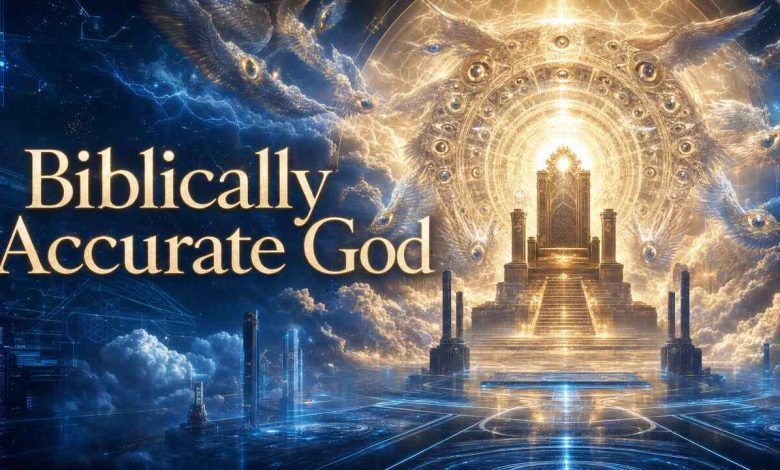
If you have spent any time online lately, you have probably seen the wave of “bBiblically Accurate God” art. Wheels covered in eyes. FBiblically Accurate Godour-faced creatures with wings on every side. It is strange, unsettling, and honestly kind of fascinating.
That trend has sparked a bigger question for a lot of people. If angels look nothing like the soft, glowing figures we grew up picturing, what about God? What does a biblically accurate God actually look like, according to the text itself?
This question is not just internet curiosity. It touches on some of the oldest and most debated parts of Christian, Jewish, and Islamic theology. Let’s walk through what the Bible actually says, section by section, so you can see the full picture instead of just the meme version.
What Does “Biblically Accurate God” Even Mean?
Before we get into specific verses, it helps to define the term itself, since it gets thrown around loosely online.
A biblically accurate God description means one drawn strictly from the text of Scripture, not from later art, film, or popular imagination. It sets aside Renaissance paintings of an old man with a white beard sitting on a cloud and asks instead: what do the actual biblical writers describe when they claim to have encountered God directly?
The short answer is that Scripture gives us very little in the way of a fixed physical form. Instead, it gives us fire, light, storm, voice, throne visions, and repeated warnings that no one can see God’s face and live. That combination is a lot stranger, and a lot more interesting, than a bearded figure on a cloud.
Why the Question Feels Confusing at First
Part of the confusion comes from mixing up different figures. Angels, cherubim, seraphim, and God himself are described separately in the Bible, and they are not interchangeable.
The viral “biblically accurate angel” images are actually drawing from descriptions of cherubim and ophanim in Ezekiel, not from descriptions of God’s own body. Keeping these categories separate is the first step toward understanding what a biblically accurate God really looks like in the text.
The Bible’s Core Claim: God Is Spirit, Not a Body
The clearest theological statement on this topic comes from the Gospel of John. Jesus tells the Samaritan woman at the well that God is spirit, and that those who worship him must worship in spirit and truth.
This single line shapes almost everything else. In Christian theology, God does not have a physical body the way humans do. He is not limited by space, matter, or a single location. That is a foundational point, and it means any “biblically accurate God” image is automatically a compromise, an attempt to render the infinite in finite form.
Old Testament Warnings Against Making an Image of God
The second commandment forbids making a carved image or likeness of anything in heaven above to worship. This was not just about false gods. It was also a direct instruction not to try to capture God’s form in physical representation at all.
Deuteronomy adds a striking detail. When the Israelites heard God speak at Mount Sinai, out of the fire, Moses reminds them that they saw no form of any kind. They only heard a voice. That detail is easy to miss, but it is central to the whole discussion.
So in a real sense, the most biblically accurate response to “what does God look like” is that Scripture deliberately withholds a clear visual answer, and treats that withholding as important.
Moments Where People Do See Something: Theophanies Explained
Even though God is described as spirit, the Bible is full of moments where people experience something visible, audible, or physically overwhelming in God’s presence. Theologians call these theophanies, meaning appearances of God.
These passages are the closest thing we get to a biblically accurate God description, so they deserve a close look.
Moses and the Burning Bush
In Exodus 3, Moses encounters God as a fire burning inside a bush that is never consumed. God speaks from within the flame, but no body or face is described. Fire becomes one of the most consistent symbols connected to God’s presence throughout the Old Testament.
The Cloud and Fire on Mount Sinai
When God descends on Mount Sinai in Exodus 19, the mountain is covered in smoke, fire, thunder, and a trumpet blast that grows louder over time. The ground itself trembles. Again, there is no described face or body, only overwhelming natural phenomena and sound.
Moses and the Request to See God’s Glory
Exodus 33 contains one of the most direct statements in the entire Bible on this subject. Moses asks to see God’s glory. God responds that no one can see his face and live, then places Moses in the cleft of a rock and lets his glory pass by, allowing Moses to see only his back.
This passage is often cited as the clearest boundary line in Scripture. Even Moses, described elsewhere as speaking with God face to face in a manner of intimacy, is not permitted a full, direct view of God’s form.
Isaiah’s Vision of the Throne
In Isaiah 6, the prophet sees God seated on a high throne, with the train of his robe filling the temple. Isaiah does not describe God’s face or limbs in physical detail. Instead, the focus shifts immediately to the seraphim surrounding the throne, six-winged beings calling out that the whole earth is full of God’s glory.
Isaiah’s own reaction is fear and a sense of being undone, not calm observation. That emotional response shows up again and again in these encounters.
Ezekiel’s Vision of the Throne-Chariot
Ezekiel 1 gives us the source material for most of the “biblically accurate angels” internet trend. Ezekiel sees a storm coming from the north, with a great cloud, flashing fire, and a brightness surrounding it.
Inside that vision are four living creatures, each with four faces and four wings, and beside them are wheels described as a wheel intersecting within a wheel, with rims full of eyes all around. Above all of this is a throne, and above the throne is a figure Ezekiel describes only as having the appearance of a man, seated in radiance like glowing metal and fire, surrounded by a rainbow-like glow.
This is genuinely one of the closest things the Bible offers to a physical description connected to God, and even here, the language stays deliberately indirect. Ezekiel repeats the phrase “the appearance of the likeness” multiple times, layering distance between the vision and any concrete claim about God’s actual form.
Daniel’s Vision of the Ancient of Days
Daniel 7 introduces the title “the Ancient of Days,” describing a figure whose clothing is white as snow and whose hair is like pure wool, seated on a throne of fiery flames with wheels of burning fire. A river of fire flows from before him, and thousands upon thousands attend him.
This is the passage most responsible for the classic Western image of God as an elderly white-haired figure. It is worth noting that Daniel’s vision is explicitly symbolic and apocalyptic in genre, meant to convey authority, judgment, and eternity rather than to serve as a literal portrait.
What the New Testament Adds to the Picture
The New Testament shifts the conversation in a significant way through the person of Jesus.
Jesus as the Image of the Invisible God
Colossians describes Jesus as the image of the invisible God. Hebrews calls him the exact representation of God’s being. In Christian theology, this becomes the primary answer to the question of what God looks like in human terms. Rather than pointing back to fire and wheels, the New Testament points forward to a person.
John’s Gospel reinforces this directly, stating that no one has ever seen God, but that Jesus, described as being close to the Father’s heart, has made him known.
Revelation’s Vision of the Throne Room
Revelation 4 returns to throne-room imagery similar to Ezekiel’s. John sees someone seated on a throne with an appearance like jasper and carnelian, with a rainbow around the throne resembling an emerald. Around the throne are four living creatures covered with eyes, echoing Ezekiel’s imagery once more.
Once again, the description leans on precious stones, light, and color rather than a defined face or body.
Comparing the Different Visions Side by Side
It helps to line these accounts up together, since patterns start to appear once you do.
- Moses and the burning bush: fire, voice, no form.
- Sinai: cloud, fire, thunder, no form.
- Moses and God’s glory: back only, face forbidden.
- Isaiah’s throne vision: glory, robe, seraphim, no described face.
- Ezekiel’s chariot vision: fire, radiance, a man-like figure at a great distance of description.
- Daniel’s Ancient of Days: white hair, fiery throne, symbolic and apocalyptic.
- Revelation’s throne room: jewels, rainbow light, no face described.
The consistent thread across nearly every genuine theophany is light, fire, and glory standing in for a body, rather than a face or clear human form. That pattern is the closest thing to a biblically accurate God image the text offers, and it is far more abstract than most popular art suggests.
Why the “Biblically Accurate Angels” Trend Took Off
It is worth pausing on why this whole conversation became a viral moment in the first place. Ezekiel’s wheels within wheels, covered in eyes, are genuinely bizarre compared to the soft-winged angels of greeting cards and church windows.
People online started applying the same “what does the text really say” question to angels first, since the gap between popular depictions and the actual descriptions was so wide and, frankly, funny. That same curiosity naturally spread to God himself, since the throne visions in Ezekiel, Isaiah, and Revelation are tied directly to angelic imagery.
The Gap Between Art History and Scripture
Centuries of Western religious art gave us the bearded man in flowing robes, largely influenced by Daniel’s Ancient of Days and by classical depictions of Zeus-like father figures in Greco-Roman art. Michelangelo’s ceiling in the Sistine Chapel cemented that image for generations, even though it was never meant as a literal theological claim.
Understanding a biblically accurate God means separating that inherited art tradition from what the biblical authors were actually trying to convey, which was overwhelming holiness rather than a specific facial structure.
How Different Religious Traditions Read These Passages
The idea of a biblically accurate God does not sit the same way across every tradition that reads the Hebrew Bible and the New Testament, so it helps to look at a few angles.
Jewish Interpretation
In Jewish thought, the ban on images of God is taken very seriously, and it shapes worship practice to this day. The name of God itself is treated with such reverence that many traditional Jewish writings avoid spelling it out fully. The throne visions in Ezekiel became the foundation of an entire branch of mystical study called Merkabah mysticism, which focused on the chariot vision rather than trying to define God’s physical appearance.
Christian Interpretation
Christian theology generally holds that God the Father remains without physical form, while God the Son, Jesus, took on a real human body at a specific point in history. This is why so much Christian art focuses on depicting Jesus rather than depicting God the Father directly. The doctrine of the incarnation becomes the theological answer to a question the Old Testament leaves open.
Islamic Interpretation
Islam takes an even firmer position against any visual representation of God, teaching that nothing resembles him and that attempts to depict him in art are strictly forbidden. While the Quran is a separate text from the Bible, this shared caution around divine imagery shows up across all three major monotheistic traditions rooted in the same ancient Near Eastern context.
The Symbolism Behind Fire, Light, and Glory
It is worth slowing down on why fire and light show up so often in these passages, since the repetition is not accidental.
Fire in the ancient world was associated with purification, danger, and transformation all at once. It destroys what touches it carelessly, yet it also refines metal and gives light in darkness. Using fire as a stand-in for God’s presence communicates holiness and power without pinning that power to a fixed shape.
Light works in a similar way. Something radiant is visible, yet it is nearly impossible to look at directly or describe in precise detail. That tension between visibility and unknowability seems to be exactly the point the biblical writers were making. A biblically accurate God is not hidden, but he is also not fully containable within human sight.
The Role of Clouds and Smoke
Clouds appear again and again alongside fire, particularly in the wilderness narratives of Exodus and Numbers, where a pillar of cloud leads the Israelites by day and a pillar of fire leads them by night. Smoke fills the temple in Isaiah’s vision the moment the seraphim call out God’s holiness.
Clouds partially reveal and partially conceal at the same time, which fits the overall pattern found throughout Scripture. God is present, close, and active, yet never fully exposed to human sight in a way that would let anyone claim a complete visual record.
What Artists Have Done With This Ambiguity
Given how much restraint the Bible shows, it is interesting to trace how artists across history filled in the gaps anyway.
Early Christian art largely avoided depicting God the Father at all, often using a hand reaching down from a cloud as a symbol of divine action instead of a full figure. Byzantine icon painters focused heavily on Christ and the saints rather than attempting a portrait of the Father.
It was really the Renaissance period, centuries after the biblical texts were written, that popularized the image most people picture today. Painters combined Daniel’s Ancient of Days imagery with classical Greco-Roman portrayals of powerful, bearded male deities like Zeus or Jupiter. That blended image became so widespread in churches, textbooks, and later film and television that many people now assume it came straight from Scripture, when it actually came from a much later artistic tradition layered on top of a handful of symbolic verses.
Bringing It All Together
So what does a biblically accurate God look like? Based on the text itself, the honest answer is that Scripture resists giving a fixed answer on purpose. God is described as spirit, then encountered through fire, cloud, glory, and throne visions that stretch human language to its limits.
The closest thing to a stable, consistent answer the Bible gives us is Jesus, described as the visible image of the invisible God. Everything before that, from the burning bush to Ezekiel’s wheels of fire, points toward something too vast and holy for a single portrait to hold.
That might be less satisfying than a tidy meme image, but it is a lot closer to what the biblical writers were actually trying to say.