
Crucial Conversations PDF: What to Know Before You Download a Copy
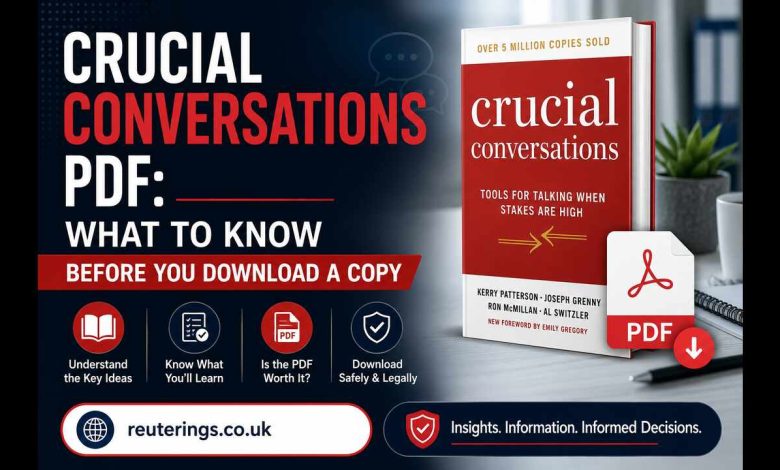
If you’ve typed “crucial conversations pdf” into a search bar, you’re probably one of two people: someone who was told to read this book for work or school and needs it fast, or someone who’s curious about the ideas before spending money on a copy. Either way, you’re not alone Crucial Conversations PDF: Tools for Talking When Stakes Are High is one of the most assigned communication books in corporate training, and searches for a free copy are common.
Here’s the short version: there’s no authorized free PDF of the full book. That’s not really bad news, though. What you actually need the framework, a sense of whether the book is worth your time, and a legitimate way to read it is covered below.
What Is Crucial Conversations PDF About?
Crucial Conversations: Tools for Talking When Stakes Are High is a business and communication book by Kerry Patterson, Joseph Grenny, Ron McMillan, and Al Switzler, first published in 2002 by McGraw-Hill. A second edition followed in 2012, and a third edition with Emily Gregory joining as a co-author arrived in 2021, adding material on digital communication and a new chapter on how to respond when someone else opens a hard conversation with you.
The book grew out of a research project. The authors spent years studying people who were unusually good at handling hard conversations: situations where opinions clashed, feelings ran high, and the outcome actually mattered. Rather than writing about theory, they built a practical model based on what these people did differently, from how they thought before speaking to how they kept a conversation from turning into an argument or a standoff, while still getting real results without damaging the relationship.
The book has sold more than five million copies, been translated into dozens of languages, and carries a foreword from Stephen R. Covey, author of The 7 Habits of Highly Effective People, along with praise from other well-known authors including Angela Duckworth. It’s a regular pick for corporate leadership training, HR programs, healthcare communication courses, and MBA classrooms, which is a big part of why so many people search for a fast way to access it.
Why So Many People Search for a “Crucial Conversations PDF”
The search makes sense once you look at who’s typically doing it. Common reasons include:
- A manager was assigned the book ahead of a training session and needs it by tomorrow.
- A student wants to preview a chapter before deciding whether to buy it for a course.
- Someone heard about the STATE method or the “pool of shared meaning” secondhand and wants the original source.
- A reader wants to compare a chapter or two against a used copy before committing to the full price.
None of these reasons are unreasonable. The catch is that most “free PDF” results for a popular, still-in-print business book lead to unofficial copies, not anything sanctioned by the publisher.
Is There a Free, Legitimate Crucial Conversations PDF?
No. Crucial Conversations PDF is an actively sold, copyrighted book published by McGraw-Hill, and there’s no free, authorized full-text PDF from the authors or the publisher. Files that claim to offer one usually hosted on file-sharing sites, forums, or generic “download any book” pages are unauthorized copies, not a legal stand-in for buying or borrowing the book.
Why Downloading an Unofficial PDF Is a Bad Trade-off
A few practical reasons to skip these downloads, beyond the copyright problem:
- They’re often outdated. Many unofficial copies online are scans of the first or second edition, missing the third edition’s updates on remote and digital communication.
- Quality is inconsistent. Scanned or OCR’d copies frequently have missing pages, broken formatting, or garbled text, especially around the book’s diagrams.
- The sites carry real risk. Pages advertising free downloads of bestselling books are a common source of malware, intrusive ad networks, and fake “verify you’re human” prompts built to collect personal information.
- You lose the extras. A legitimate copy connects you to the publisher’s actual support material, something a stray file never will.
Legitimate Ways to Read (or Listen to) Crucial Conversations
If the goal is to actually use the book rather than just check a box, there are several low-cost ways to get the real thing:
- Buy the ebook or paperback. Both typically cost less than a dinner out, and the ebook is available right away.
- Borrow it from your library. Apps like Libby, OverDrive, and Hoopla let you borrow the ebook or audiobook with a library card, at no cost.
- Try the audiobook. It’s available on Audible and similar platforms, which works well if you’d rather listen during a commute or a workout.
- Check with your employer first. If your company is rolling out Crucial Conversations PDF training, it may already have licensed copies or access through a corporate learning platform, so it’s worth asking before you buy your own.
- Look for a used copy. The book has been printed by the millions since 2002, so secondhand copies are easy to find through resale marketplaces or local used bookstores for a few dollars.
Free Resources Straight From the Publisher
Crucial Learning, the company founded by the book’s authors, offers real free material tied to the book on its official site: a printable summary of the model, a short “Style Under Stress” self-assessment, discussion questions for teams or book clubs, and a long-running advice column called Crucial Skills. None of this replaces the full book, but it’s a legitimate, no-cost way to get a feel for the material before you buy.
The Core Framework: What You’ll Actually Learn Inside
Instead of chasing a rough copy of the text, it helps to know what the book actually covers. Here’s a look at the model, piece by piece.
What Makes a Conversation “Crucial”
The authors define a crucial conversation as one where three things are true at once: the stakes are high, opinions differ, and emotions run strong. A performance review, a conversation about ending a relationship, or a disagreement about a family inheritance would all qualify. A conversation about where to order lunch wouldn’t, even if voices get raised.
Two Ways Dialogue Breaks Down: Silence and Violence
When people feel unsafe in a conversation, they tend to react in one of two directions:
- Silence: Holding back honest input. This shows up as masking (sugarcoating or joking instead of saying what you mean), avoiding (steering around the real topic), and withdrawing (leaving the conversation or the room).
- Violence: Forcing a point of view onto someone else. This shows up as controlling (interrupting, dominating, or overstating your case), labeling (dismissing a person or idea with a stereotype), and attacking (belittling or threatening).
Neither pattern gets anyone what they actually want. The book treats both as signals, not personality flaws, that safety has broken down and needs repair before the real topic can move forward.
The Pool of Shared Meaning
This is the book’s central image: every fact, feeling, and opinion each person brings to a conversation flows into a shared “pool.” The more openly people add to that pool, instead of holding back or forcing their view, the smarter and faster the resulting decision tends to be. Most of the book’s tools exist to keep that pool as full and open as possible.
Start With Heart
Before any difficult conversation, the book asks readers to check their own motives with a simple question: what do I really want here, for myself, for the other person, and for the relationship? This step is about noticing when you’ve quietly shifted from wanting a good outcome to wanting to win, be right, or punish the other person.
Learn to Look
This skill is about catching the early signs that a conversation is turning crucial or unsafe: a change in tone, a sharp joke, a sudden silence. Catching these early keeps a conversation from spiraling into full withdrawal or open conflict.
Make It Safe
When a conversation starts to break down, the fix usually isn’t the topic, it’s safety. The book points to two specific conditions people need to feel before they’ll speak honestly: mutual purpose (they believe you care about what they want, not just what you want) and mutual respect (they believe you see them as an equal). Rebuilding either one, even briefly, is often enough to get a stalled conversation moving again.
Master My Stories
People rarely react to raw facts. They react to the story they’ve built around those facts. The book teaches readers to separate the two: a fact is something a video camera could record (“the report was three days late”), while a story is the interpretation layered on top (“they don’t respect my time”). Readers are asked to watch for three common story types that let people avoid responsibility: playing the victim, painting the other person as the villain, or claiming to be helpless to do anything differently.
STATE Your Path
This is the book’s best-known tool: a five-part method for sharing a tough message without triggering defensiveness.
- Share your facts: Start with the most objective, least controversial observation.
- Tell your story: Explain your interpretation, clearly labeled as your interpretation.
- Ask for others’ paths: Invite the other person’s view before you push your own further.
- Talk tentatively: Present opinions as opinions, not established truth.
- Encourage testing: Make it genuinely safe for the other person to disagree with you.
For example, a manager addressing a pattern of missed deadlines might say: “The last two reports came in after the deadline” (fact), “I’m reading that as the workload not being sustainable right now” (story), “What’s actually going on?” (asking) rather than opening with “You clearly don’t care about deadlines anymore.”
Listen to Others’ Paths
The flip side of STATE is listening well when someone else is upset or has gone quiet. The book’s listening tools, grouped under the acronym AMPP, include asking open questions, mirroring the emotion you’re noticing, paraphrasing what you heard back to them, and priming, which means offering a guess at what they might be thinking when they’re too guarded to say it themselves.
Move to Action
A good conversation that doesn’t lead anywhere is still a failed one. The book closes its model by pushing readers to leave every crucial conversation with a clear decision: who does what, by when, and how you’ll follow up, so agreements don’t quietly fall apart once everyone leaves the room.
How These Skills Show Up in Everyday Life
The model reads cleanly on paper. The harder part is using it under pressure. A few common situations where these tools tend to get tested:
- Giving a direct report tough feedback. Leading with an observable fact instead of a judgment, such as “the deck wasn’t ready for the 9 a.m. meeting” instead of “you’re not taking this seriously,” keeps the other person from going straight into defense mode.
- A disagreement about money with a partner. Naming what you actually want, such as financial security rather than winning the argument, before getting into who spent what tends to keep the conversation from turning into a scorecard.
- A roommate or family chore dispute. Asking “how do you see this going lately?” before stating your own frustration opens space for a two-way conversation instead of a lecture.
- Pushback in a team meeting. Talking tentatively, such as “here’s how I’m seeing it, what am I missing?” instead of stating an opinion as fact, makes it easier for quieter team members to raise a different view.
None of these examples require getting every step perfect. The book’s own point is that people who handle these situations well aren’t naturally calmer or more patient than everyone else. They’ve just practiced noticing the moment a conversation is about to go sideways, with a next move ready.
Who Tends to Get the Most Out of This Book
Crucial Conversations PDF shows up across a wide range of settings, which is part of why it stays in print more than two decades after its first release:
- Managers and team leads. Handling feedback, conflict, or underperformance.
- HR and learning-and-development professionals. Running communication or leadership training.
- Healthcare workers. Where the book’s framework is frequently used in patient-safety and team communication training.
- Couples and families. Working through recurring disagreements.
- Anyone preparing for one specific hard conversation. Such as a resignation, a difficult diagnosis to share, or a business partnership ending.
It’s also common reading in MBA and executive education programs, which adds a steady stream of readers searching for a fast way to access the material before an assignment is due.
Editions, Related Books, and Companion Tools
A few details worth knowing if you’re deciding which copy to get:
- Editions: first edition (2002), second edition (2012), and third edition (2021), which added a chapter on responding when someone else starts a crucial conversation with you, plus material on communicating across digital channels. If you’re buying new, the third edition is the current standard.
- Related titles by the same author team: Crucial Accountability (originally published as Crucial Confrontations in 2004, retitled in 2013 with David Maxfield added as a co-author), which focuses on following up after someone breaks a promise or misses a commitment; Crucial Influence (originally published as Influencer); and Change Anything.
- Unofficial workbooks and summaries: a number of independently published workbooks and chapter summaries are sold on marketplaces like Amazon. These aren’t written by the original authors and shouldn’t be confused with the book itself, though some readers use them alongside the original text for extra practice.
- The company behind it: the authors co-founded a training company called Vital Smarts in 1989, which rebranded as Crucial Learning in 2021. Crucial Learning now runs in-person, virtual, and on-demand certification courses built around the book.
Frequently Asked Questions
Is there an official free PDF of Crucial Conversations?
No. The book is still commercially sold by McGraw-Hill, and neither the authors nor Crucial Learning offer a free full-text PDF. The publisher’s website does offer free companion material, including a model summary and a self-assessment, but not the complete book text.
What are the main skills taught in Crucial Conversations?
The book centers on seven core skills: starting with heart, learning to look for signs of unsafe dialogue, making conversations safe, mastering your own stories about a situation, stating your view through the STATE method, hearing the other person’s view through active listening, and moving to a clear action plan.
How long does it take to read Crucial Conversations?
The third edition runs about 300 pages. Most readers get through it in four to six hours of straight reading, though plenty of people work through it more slowly, a chapter at a time, alongside a training course.
Is Crucial Conversations worth reading if my workplace already trains on it?
Usually, yes. Training sessions tend to cover the model at a high level in a few hours, while the book has room for the research background, extended examples, and nuance that a single session often skips.
What’s the difference between Crucial Conversations and Crucial Accountability?
Crucial Conversations PDF covers how to talk through a disagreement or high-stakes topic in the moment. Crucial Accountability is more specific: it focuses on what to do after someone has broken a promise, missed a deadline, or violated an expectation.
Is there an audiobook version of Crucial Conversations?
Yes. It’s available as an audiobook through Audible and similar platforms, and through most library audiobook apps at no cost with a library card.
Which edition of Crucial Conversations should I buy?
The third edition, from 2021, is the current version and the one most training programs now reference, since it includes updated material on remote and digital communication that the first two editions don’t cover.
Final Thoughts
The search for a “crucial conversations pdf” almost always comes down to wanting fast, low-effort access to a book a lot of people are told to read on short notice. That’s a fair thing to want, but a stray, unauthorized file isn’t a shortcut to the actual value of the book, which comes from practicing the model rather than just reading about it once.
A borrowed library copy, a modestly priced ebook, or the free assessment and model sheet on the publisher’s site will get you further than a low-quality scan ever could. And if you only take one thing from the book without reading another page, try this: before your next hard conversation, pause and ask what you actually want from it. That single habit is where most of the book’s other skills begin.
Read interesting Information About Blogs, Entertainment At: reuterings.co.uk
