Jablje: The Slovenian Castle That Quietly Steals Your Heart
I still remember the first time someone said the word “Jablje” to me. I mispronounced it, laughed at myself, and asked where on earth it was. A friend from Ljubljana just smiled and said, “You have to see it. Words won’t do it justice.” She was right. Jablje is one of those places that doesn’t shout for attention, yet once you know it exists, you can’t stop thinking about it.
If you’re planning a trip to Slovenia, or you’re simply someone who loves old stone walls, quiet gardens, and stories that stretch back centuries, this post is for you. We’re going to walk through the history of Jablje, talk about what makes it different from other Slovenian castles, and figure out why so many travelers now search for it before they even land in the country.
What Is Jablje, Really?
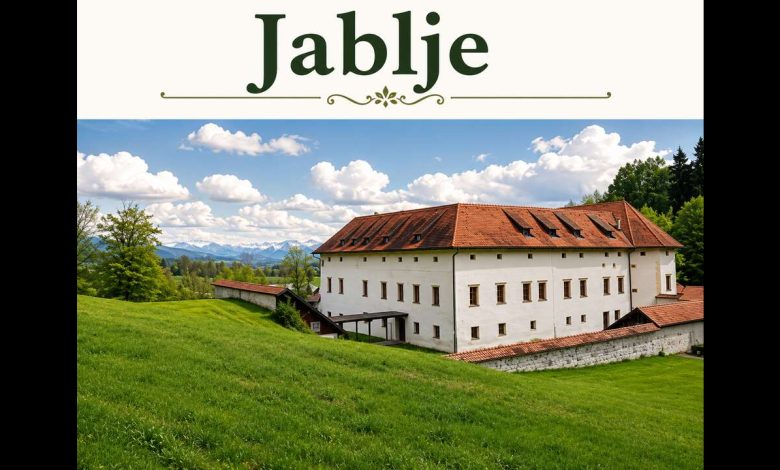
Jablje is a historic estate centered around Jablje Castle, sitting near the village of Loka pri Mengšu, within the Municipality of Mengeš. It rests on the western edge of the Mengeš Plain, close enough to Ljubljana for an easy day trip, yet far enough removed that the pace of the capital fades away almost immediately.
Locally, you’ll also hear it called Grad Jablje or Grad Jable, and older documents sometimes use the German name Habach or Habah. All of these names point to the same spot: a Renaissance-era manor with roots that go back to the Middle Ages, standing quietly above a village most tourists have never heard of.
What strikes me most about Jablje is how it manages to be both grand and modest at once. It isn’t a fairy-tale fortress with soaring towers designed to intimidate. It’s something warmer, more livable, a place that feels like it was built for people rather than for war.
A Name Rooted in the Land
Here’s a detail I love: the name Jablje is believed to come from the old Slovene word for apple tree. Some sources use the earlier form “Jable” to make that connection even clearer. Given how agricultural this stretch of central Slovenia has always been, orchards, fields, and farmland woven into everyday life, it makes sense that the name would grow out of the land itself rather than out of a noble family or a battle.
That small linguistic thread matters because it changes how you experience the place. You’re not just walking up to a monument built to project power. You’re walking into a name that literally grew from the soil, from apple trees that likely stood here long before any stone was laid.
The Story Behind Jablje’s Walls
From a Written Record in 1268 to a Renaissance Home
The written history of Jablje reaches back to 1268, which is the earliest documented reference to the site. That’s genuinely old, older than most buildings still standing anywhere in Europe. But the structure most visitors see today doesn’t date from that early period. What stands at Jablje now is generally traced to the first half of the sixteenth century, with many records pointing to around 1530.
So there’s a gap of over 250 years between the first mention of the site and the castle we recognize today. A lot happened in that gap: rebuilding, expansion, and the slow transformation from a medieval defensive structure into something closer to a noble residence. The bones of Jablje are late Gothic, but what you actually see when you approach is shaped by the Renaissance and, later, the Baroque period.
Families Who Called Jablje Home
No castle tells its own story. People do that. And Jablje passed through the hands of several noble families over the centuries, each one leaving a mark on how it looks and feels today.
The aristocratic Lamberg family is generally credited with giving Jablje its current form in the sixteenth century, rebuilding it in Renaissance style and adding the arcaded courtyard that still anchors the castle’s interior. After the Lambergs, ownership shifted to the Rasp family, then to the barons Mosconi. From 1780 until the end of the Second World War, Jablje belonged to the barons Lichtenberg.
Each family brought its own priorities, its own taste, its own sense of what a home should look like. That’s part of why Jablje feels layered rather than uniform. You’re not looking at one architect’s vision. You’re looking at generations of decisions stacked on top of each other, softened by time into something coherent.
What Jablje Looked Like Through War and Change
History rarely spares old buildings, and Jablje is no exception. It survived the Second World War largely intact, which is more than can be said for many estates of its era. But surviving a war and surviving what came after are two different things.
In the years following the war, the castle was nationalized. Its contents were scattered, some pieces looted, and the building itself was repurposed in ways its original owners could never have imagined. At different points, Jablje served as housing divided into apartments and later as an experimental facility connected to the Biotechnical Faculty of the University of Ljubljana.
I find this part of the story oddly moving. A building meant for elegant gatherings and family life became, for a time, something entirely functional and almost forgotten by the wider public. It’s a reminder that grand architecture doesn’t guarantee a smooth future. Buildings, like people, go through hard chapters.
Thankfully, Jablje’s story didn’t end there.
The Turning Point: Restoration and Renewed Purpose
Between 1999 and 2006, Jablje underwent a thorough renovation. This wasn’t a cosmetic touch-up. It was a serious effort to bring the estate back to something close to its former dignity, repairing structural damage and restoring interior details that had faded or been lost during decades of institutional use.
The timing turned out to be significant. In 2008, when Slovenia held the presidency of the European Union, Jablje served as a major protocol site, hosting official gatherings and representing the country on something close to a European stage. It’s a striking image: a castle that had spent years as a laboratory and a set of apartments suddenly welcoming diplomats and dignitaries.
Today, Jablje hosts the Center for European Perspective, an organization connected to policy and regional cooperation work. The castle and its surrounding grounds are also formally recognized as a cultural monument of state importance, which means Jablje’s future is now protected in a way it wasn’t during those uncertain postwar decades.
Walking Through Jablje Today
The Architecture Up Close
If you visit Jablje now, what you’ll notice first is the arcaded courtyard, a Renaissance feature built around the start of the seventeenth century. It gives the whole structure a sense of openness that a lot of medieval castles simply don’t have. Instead of narrow, defensive corridors, you get light, symmetry, and a courtyard that clearly wasn’t built with siege warfare in mind.
The exterior blends styles in a way that rewards a slow look rather than a quick photo. The underlying shape is medieval, but the details, the proportions, the ornamentation, speak to the Renaissance and Baroque periods layered on top. It’s less about one dramatic silhouette and more about noticing small choices: a window frame here, an arch there, each one telling you something about the era that added it.
The Frescoes Worth the Trip Alone
For me, the real showstopper at Jablje is inside: a set of frescoes by the Baroque painter Franc Jelovšek. Among them is an image that tends to surprise first-time visitors, a depiction of a camel-riding musician playing a tambourine. It’s playful, unexpected, and a little strange in the best way, a small reminder that even serious noble households had room for whimsy and curiosity about the wider world.
Standing in front of that fresco, I remember thinking about how much effort it takes to commission something so specific and unusual. Someone chose that image on purpose. Someone wanted their guests to look up and smile. Centuries later, it still works.
The Grounds and Surrounding Landscape
Jablje wasn’t only a house; it was an estate, and traces of that wider landscape survive. A fishpond sits near the castle, along with a stone well and remnants of a park wall that once framed the garden. A chestnut avenue used to connect the castle to the nearby town of Loka pri Mengšu, and the old pathway leading up to the entrance was once decorated with an iron pergola wrapped in wisteria.
Not everything from that era survived. The barns, outbuildings, an icehouse, and a carriage shed that once stood within the castle wall are gone now. But the stables and a traditional drying rack, known locally as a “toplar,” a structure typical of the wider Dolenjska farming tradition, remain in the lower part of the former estate. Walking through what’s left, you get a real sense of how a working, breathing household once wrapped itself around this building, not just a museum piece frozen in time.
Why Jablje Feels Different From Other Slovenian Castles
Slovenia has no shortage of striking castles: Ljubljana Castle overlooking the capital, Predjama Castle wedged dramatically into a cliff face, Bled Castle perched above its famous lake. Jablje doesn’t try to compete with any of them on scale or drama, and that’s precisely its appeal.
Where those better-known sites lean into spectacle, Jablje leans into intimacy. It’s smaller, quieter, and closely tied to the everyday agricultural life of the region rather than to legends of sieges or fairy-tale romance. If Bled is the castle you photograph, Jablje is the one you sit with a while, the one that rewards patience over a quick glance.
There’s also something meaningful in Jablje’s modern role. Rather than functioning purely as a tourist attraction, it now houses an organization focused on European cooperation and policy work. That gives the building a living purpose again, connecting its past as a noble residence to a present that’s still, in its own way, about bringing people together.
Getting to Jablje: Practical Tips for Visitors
If you’re planning to see Jablje in person, here’s what’s worth knowing.
Location: Jablje Castle sits above the village of Loka pri Mengšu, at Grajska cesta 2, within the Municipality of Mengeš, in Slovenia’s Upper Carniola region.
Distance from Ljubljana: The site is close enough to the capital for a comfortable half-day or full-day trip, making it an easy addition to a Ljubljana-based itinerary.
What to expect on-site: Since Jablje now functions primarily as a working center rather than a full-time museum, access to interior spaces like the fresco-decorated rooms can depend on scheduled events or arranged visits. It’s worth checking ahead before you go, rather than assuming open, walk-in access every day.
Best time to visit: Late spring through early autumn tends to be ideal, when the surrounding grounds, the old fishpond, the well, and the remaining agricultural structures are easiest to appreciate without weather getting in the way.
Nearby stops: Because Jablje sits within the Mengeš area, you can easily pair a visit with a broader look at the Mengeš Plain and nearby villages, giving you a fuller picture of daily rural life in this part of Slovenia rather than just a single monument.
Why Jablje Matters in Slovenia’s Bigger Castle Story
It’s tempting to rank castles by size or fame, but that misses what makes a place like Jablje genuinely valuable. Jablje represents continuity. It shows how a single site can move from medieval defense, to Renaissance residence, to Baroque refinement, to postwar institutional use, to careful restoration, and finally to a renewed cultural role, all without losing the thread connecting it back to 1268.
That kind of layered history is exactly what makes Slovenian heritage so rich. The country isn’t only defined by its most photographed landmarks. It’s shaped just as much by places like Jablje, sites that carry centuries of change quietly, without needing a dramatic legend attached to draw people in.
If you care about understanding a country beyond its highlight reel, Jablje offers something rare: a genuine, unpolished window into how ordinary noble life, agricultural tradition, and regional history actually unfolded in central Slovenia.
A Few Reflections on Visiting Slower
One thing I’ve learned from writing about places like Jablje is that the sites worth remembering aren’t always the ones with the longest ticket lines. Some of the most rewarding travel moments come from standing somewhere quiet, reading a plaque, and letting your imagination fill in the rest: the sound of carriage wheels on the old chestnut avenue, the smell of apples from an orchard that may have inspired the name itself, the murmur of a household going about its day centuries before anyone thought to write it down.
Jablje rewards that kind of slower attention. It won’t overwhelm you with scale the way some of Europe’s grander fortresses might, but it offers something arguably more valuable: a sense of continuity, of a single piece of land carrying meaning across nearly eight hundred years of recorded history. Few places let you feel time move quite that clearly.
If you’re building a Slovenia itinerary around castles, pair Jablje with a mix of the famous and the lesser-known. Let Bled give you the postcard view, let Predjama give you the drama, and let Jablje give you the quiet, thoughtful pause in between. That contrast is often what makes a trip memorable long after you’ve come home.
Before You Go
I keep coming back to that first conversation about Jablje, the one where my friend told me words wouldn’t do it justice. She wasn’t exaggerating. There’s something about standing in that arcaded courtyard, looking up at a fresco of a camel-riding musician, knowing the ground beneath you was first written about nearly 760 years ago, that photos and articles can only hint at.
Jablje isn’t trying to be the loudest castle in Slovenia. It doesn’t need to be. It just needs you to show up, slow down, and pay attention. If you do, you’ll walk away with a much richer sense of what this small but remarkable country has been quietly holding onto all along.
So next time you’re mapping out a Slovenian itinerary, don’t let Jablje slip past you as just another name on a list. Give it the same curiosity my friend gave it when she first told me about this place. You’ll be glad you did.